

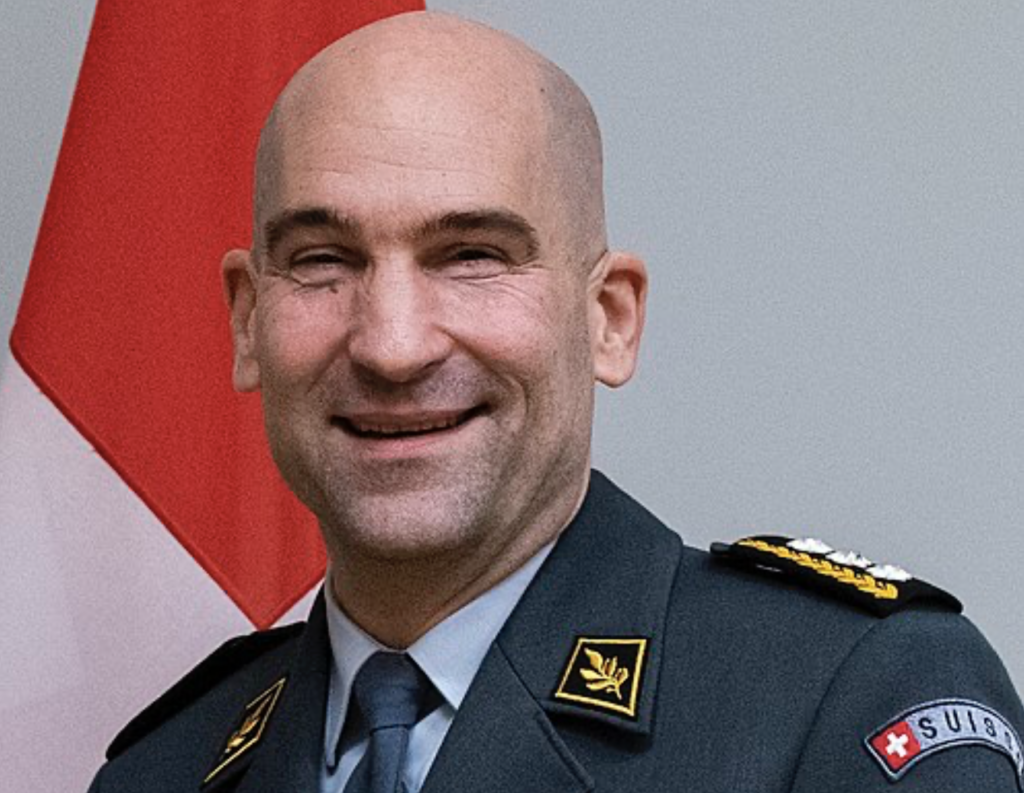
Nearly four years after Russia launched its full-scale invasion of Ukraine, Switzerland has yet to undergo a fundamental shift in its security thinking. According to the outgoing Chief of the Armed Forces, Thomas Süssli, the country remains militarily underprepared, while political reactions to the dramatically changed European security environment have been slow and insufficient.
In an interview with the Neue Zürcher Zeitung (NZZ), Süssli expressed clear frustration: “I do not have the feeling that a jolt has gone through the country since then.” In a democratic system, political authorities ultimately decide on defense spending and priorities, he acknowledged—but as army chief, he bears responsibility for the troops. Knowing that only around one third of soldiers would be fully equipped in an emergency is, in his words, deeply stressful.
False confidence in peace and neutrality
Süssli recalls 24 February 2022 as a turning point that demanded “ruthless honesty.” From the very beginning of the war, he warned that the public and political leadership must not believe the Swiss Armed Forces are capable of defending the country if this is not the case. Neutrality, often perceived as a protective shield, is no guarantee of security on its own. History, Süssli argues, shows that unarmed or poorly prepared neutral states have repeatedly been drawn into wars. Neutrality only has value if it can be defended.
Why, then, has Switzerland not fundamentally rethought its security posture? Süssli identifies three main reasons. First, the absence of collective war memory: the last armed conflict on Swiss territory—the Sonderbund War—took place in 1847. Unlike countries such as Poland or Estonia, Swiss society has no living historical experience of modern warfare.
Second, the war in Ukraine still feels distant to many citizens, despite the geographical reality. “In fact, there are only two countries between us and Ukraine,” Süssli warned, underlining how fragile the sense of distance truly is.
Third, there is a widespread belief that neutrality alone ensures safety. This assumption, according to the army chief, is historically and strategically flawed.
Too little, too late?
Even if Switzerland were to increase defense spending to one percent of GDP only in the 2030s, Süssli estimates that it would take until around 2050 for the country to become fully capable of national defense. Given the current threat environment in Europe, this timeline is dangerously long.
At the same time, the Swiss Armed Forces are attempting to adapt to rapid changes on the modern battlefield. Süssli points to an internal innovation system that allows militia soldiers to contribute ideas and technological solutions directly. Rather than purchasing fixed weapon systems years in advance, the army is increasingly relying on framework agreements—particularly in areas such as drones—to ensure access to the latest available technologies when needed.
Cyber threats and cooperation
Süssli also highlights the growing importance of cyber warfare. According to Swiss intelligence assessments, more than eighty Russian nationals with links to Russian intelligence services are believed to live in Switzerland. This underlines the shift of modern conflict away from purely conventional battlefields.
Finally, the army chief stresses that Switzerland cannot defend itself in isolation. Interoperability and cooperation with partner nations are essential, even for a neutral state. Building such capabilities, however, takes years of preparation—time that, in Süssli’s view, is already running short.
As he steps down from office at the end of the year, Süssli leaves behind a stark warning: without faster political decisions and a more realistic assessment of security risks, Switzerland risks clinging to an illusion of safety in an increasingly unstable Europe.