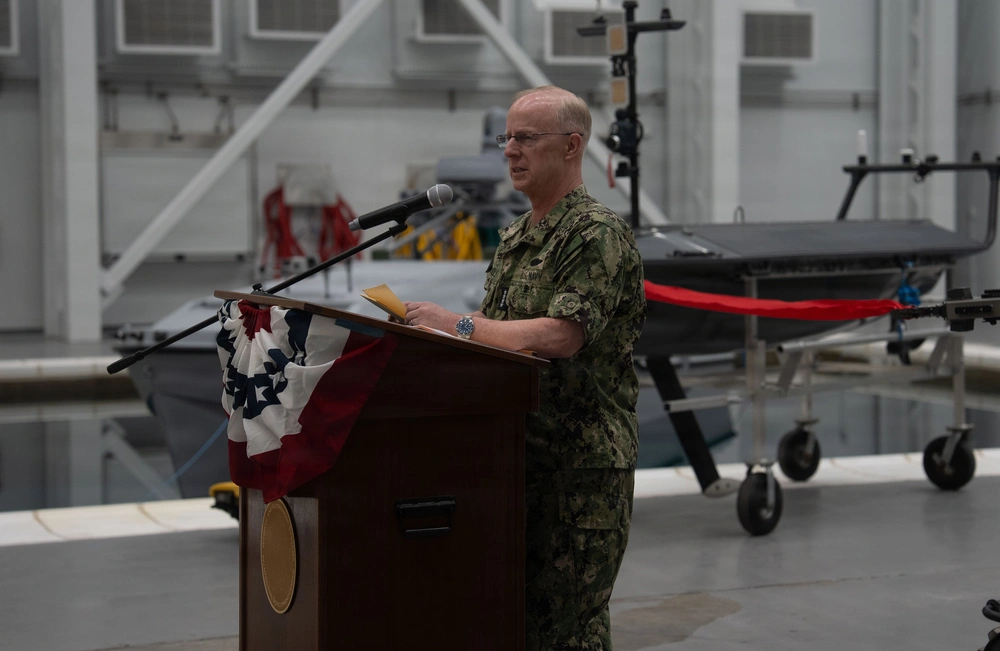
NORFOLK, VIRGINIA, UNITED STATES 09.24.2026 Photo by Petty Officer 1st Class Hannah Mohr Chief of Naval Operations
“A prototype is not combat power.”
With that unusually direct assessment, U.S. Chief of Naval Operations Adm. Daryl Caudle has summarised one of the biggest challenges facing military autonomous systems today.
The technology increasingly works. The next challenge is turning it into a capability that can be deployed, sustained and used by operational forces at scale.
The U.S. Navy has now established a dedicated organisation intended to help make that transition.
The new Robotic and Autonomous Systems Warfighting Development Center, or RASWDC, has been established at Joint Expeditionary Base Little Creek-Fort Story in Virginia.
Its mission goes beyond testing new unmanned platforms.
The centre is intended to become the Navy’s fleet-facing integration point for robotic and autonomous systems, helping translate rapidly developing technology into operational capability.
From prototype to combat capability
Military forces around the world have invested heavily in unmanned aircraft, surface vessels, underwater vehicles and autonomous systems.
But demonstrating a platform is only one part of creating combat capability.
Operational deployment requires trained personnel, doctrine, communications networks, software, logistics, maintenance and tactics that allow autonomous systems to operate alongside conventional forces.
This is the gap RASWDC is designed to address.
The centre will support experimentation, operational testing, tactics development and training while helping integrate autonomous systems into existing fleet operations.
Its remit covers systems operating in multiple domains, including unmanned aircraft, surface vessels and underwater platforms.
Autonomy at scale
The establishment of RASWDC reflects a broader shift in U.S. naval thinking.
Unmanned systems are increasingly being treated not simply as experimental technology but as an integral part of future fleet architecture.
That creates a different challenge for the Navy.
The question is no longer simply whether an autonomous system can perform a mission.
The question is whether hundreds – potentially thousands – of such systems can be reliably deployed, networked, maintained and integrated with crewed platforms during high-intensity operations.
Lessons from recent conflicts have reinforced the importance of rapidly adapting inexpensive unmanned systems, software and electronic warfare capabilities.
For major armed forces, however, scaling those technologies into established force structures remains difficult.
The creation of a dedicated warfighting development centre suggests the U.S. Navy wants to accelerate that transition.
As Caudle’s statement makes clear, technological demonstrations alone are not enough.
A prototype becomes combat power only when sailors can actually fight with it.
Source: U.S. Navy